- Semiconductors
- Industrial strategy
I recently completed my MBA thesis at MIT, focused on resilience and policy in Wide-Bandgap semiconductor value chains, particularly Silicon Carbide and Gallium Nitride.
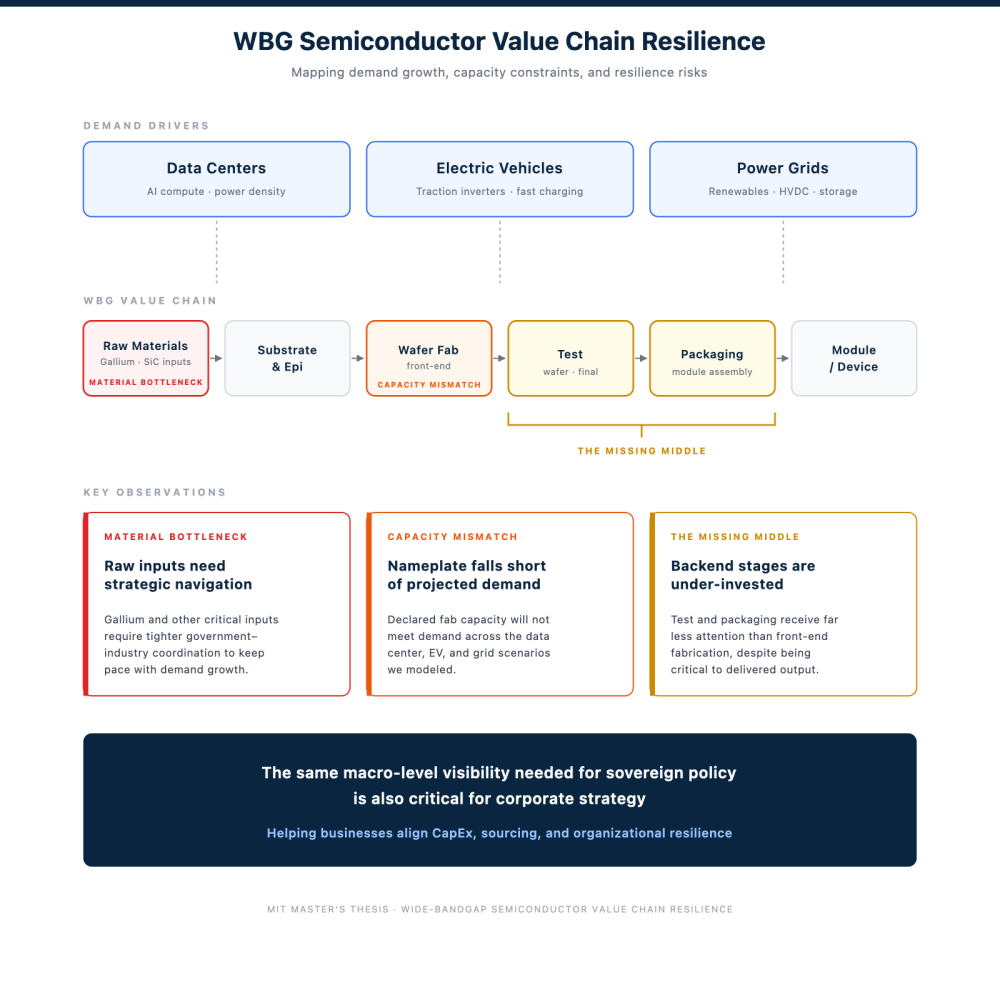
As part of this research, I modeled demand across critical applications, including data centers, electric vehicles, and power grids. I then used an algorithmic decision-support framework to map that demand against capacity, yield, sourcing, and backend constraints across the value chain.
The framework was designed to connect technical value-chain realities with stakeholder decisions. For policymakers, it helps test whether industrial goals are realistic against capacity, yield, and material constraints. For manufacturers and suppliers, it highlights where CapEx, sourcing, and backend investments may be needed. For investors and downstream customers, it provides visibility into where resilience risks may emerge.
A few themes stood out: projected demand may outpace declared capacity, backend stages such as testing and packaging remain under-invested, and upstream inputs such as gallium and substrates will require much tighter coordination between government and industry.
One of my biggest takeaways is that the same macro-level visibility needed for sovereign policy is also critical for corporate strategy. Companies navigating this complex business environment will need to embed that visibility into CapEx and strategic decisions to build resilient organizations.
A sincere thank you to Professor Saurabh Amin and Professor Alexandre Jacquillat for their guidance, support, and feedback throughout this work.